
If you want to start a debate, wonder out loud why human beings all over the world are growing less enthusiastic about having children. People definitely have opinions.
You will be told that the fall in fertility rates seen in most of the countries of the world, including the U.S., is the result of high housing costs. Or cultural changes. Or pollution reducing sperm counts. Or human psychology in a neoliberal world. Or the distraction of social media. Or despair about climate. Or all those things and more.
The thing you’ll really learn is that nobody knows.
New Hampshire has been facing this reality for a long time. Despite the occasional blip – it rose slightly this year – the number of births in the state has been falling steadily for three decades, from 14,000 a year in the 1990s to 12,000 now. Various fixes have been tried to stem the tide, such as tweaking taxes and fees or creating the stay-work-play program to lure younger and presumably more fecund people, but so far without success.
When thinking about that problem, I wondered if one cause might be a decline in Granite State marriages. So I took a look at statistics from the state Vital Records office.
The number of marriages in New Hampshire has actually been steady for at least 20 years, hovering just above 9,400 with little annual variation. But even if the numbers haven’t changed, the participants have.
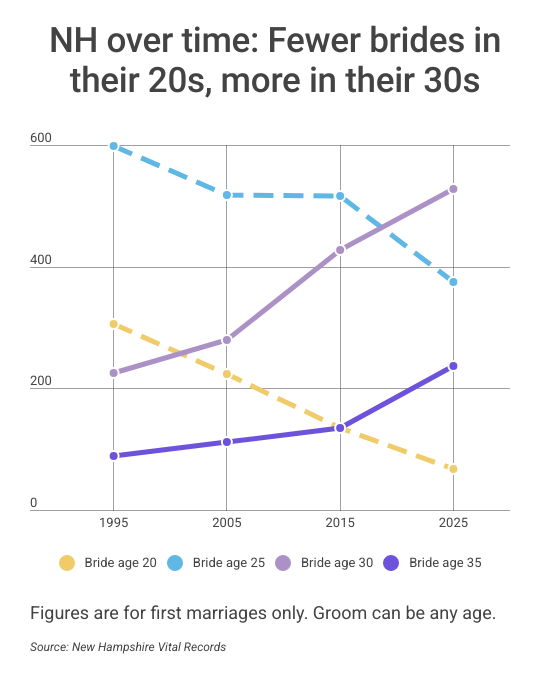
I looked at select ages of brides and grooms every five years and the pattern is clear: Fewer youngsters are walking down the aisle and more middle-age folks are doing it.
In 1995, 312 brides were age 20. Last year just 68 were, a fall of about 80 percent. In 1995, 89 brides were age 35. Last year 236 were, a seven-fold increase.
This pattern is similar for grooms.
If people are getting married a decade later in life on average, that narrows their window for having multiple kids and will put downward pressure on lifetime fertility rates. Still, I don’t think that’s a cause of our “birth dearth.” It’s more likely a symptom of the global changes that led to fewer newborns, whatever those changes might be.
Total Fertility Rate
The global issue is fertility rates, the average number of children produced by a woman during her childbearing years. That average needs to be at least 2.1 for a population to be stable; if it’s less than that, every generation will be smaller than the one before. This figure, called Total Fertility Rate or TFR, is slightly higher than 2.0 to compensate for infant mortality.
More than 100 countries now have a fertility rate below 2.1. Most are still growing slowly because of the number of young women who are entering childbearing age but some countries have already started to shrink in total population – including China, of all places.
That has drawn attention to what was once an obscure demographic datapoint. Some of that attention is serious and some is rancid, notably from racists who whip up followers by saying the “wrong” people are going to take over the world. But despite all the talk, nobody knows what to do.
Governments everywhere have found that top-down actions don’t do much to alter birth rates unless you go to the awful extremes of one-child-only China, which tried to limit births, or Romania’s Decree 770, which tried to increase them. Both were disasters at the human and national scale.
It turns out you just can’t bribe or cajole very many people into having children if they don’t want to.
The way to increase birth rates is obvious: Create a world where people do want to have children.
I have some thoughts about what needs to happen, such as reducing the nastiness of “only greed is good” capitalism and coping with climate change to reduce foreboding, but those are hard, complex goals. It’s simpler to throw a few bucks at parents or pass laws dictating women’s sexuality or give prizes to people with big families, a favorite Russian trick. These don’t work, but it looks like you’re doing something.
How big a problem is all this? If it continues for three or four generations it will be a big problem, and in the short term it will cause financial upset.
But don’t slip into existential-threat panic mode before we’re not going extinct any time soon. In fact, despite falling birth rates the global population will have increased by at least one billion human beings before you die because of all the women born two decades ago who are now able to have kids.
As for me, I’m going to ignore it and play with my three granddaughters from my two children. Sorry, we’re not at replacement level. Yet, anyway.
 Return to the Concord Monitor
While there are no doubt many factors it’s quite clear that environmental toxins play a role. Pesticides, notably, are proven to cause problems with male fertility.
The title of your article is not correct; a decrease in the “fertility rate” could be evidence of something more serious such as medical reasons why women are having trouble becoming pregnant. You are confusing fertility rates with birth rates, which are usually based on personal choices to have, or not have, children.
Furthermore, an increase in world birth rates could cause many, serious problems. Imagine if the average rates around the world were to increase to where more couples were having at least several, or more children. Then there would be serious population problems.
For better or worse, “total fertility rate” is the accepted term