
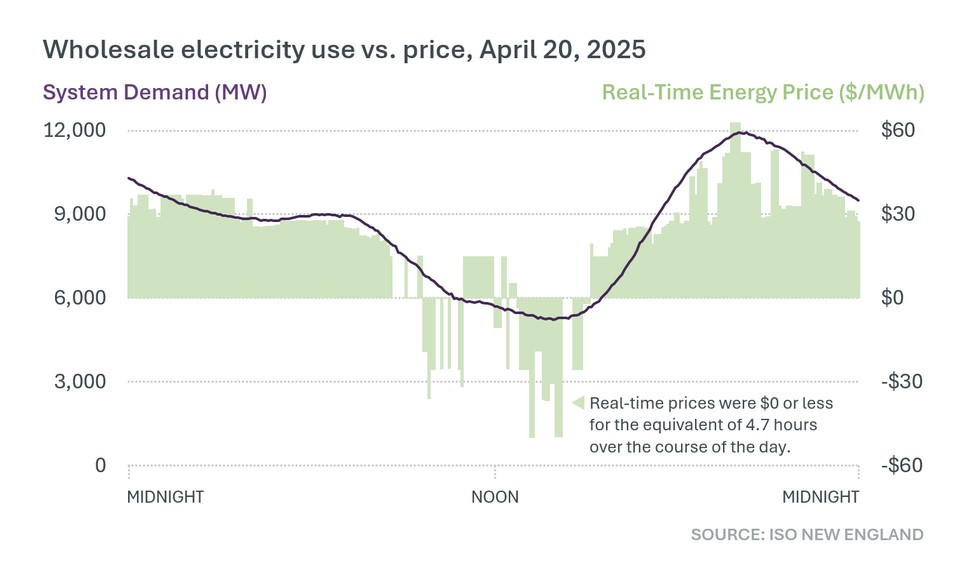
What does it mean that electricity prices in New England are sometimes negative? ISO-NE has an explainer, here. A key point, not obvious to us outsiders:
Negative prices haven’t had a dramatic effect on overall wholesale electricity costs. They occur primarily in the Real-Time Energy Market, but they are rare in the Day-Ahead Energy Market, where the majority of the region’s energy transactions take place. In 2025, real-time energy prices averaged $65.88 per megawatt-hour — comparable to the day-ahead average for the year.
Negative prices don’t last very long because the market responds quickly to changing system conditions. When prices drop, resource owners have less incentive to sell electricity, and so they may reduce output. Or, if energy prices are higher in neighboring regions, they may choose to export electricity.
And this:
Even though solar facilities have no fuel costs, solar makes up a comparatively small share of negative offers. That’s because most of the region’s solar facilities do not participate in the energy markets. However, the fleet of participating solar installations is growing, as reflected in a greater amount of negative offers in 2024.
Note that last weekend we hit a new record for utilty-level solar, although it’s still less than 1,000 MW.
 Return to the Concord Monitor