
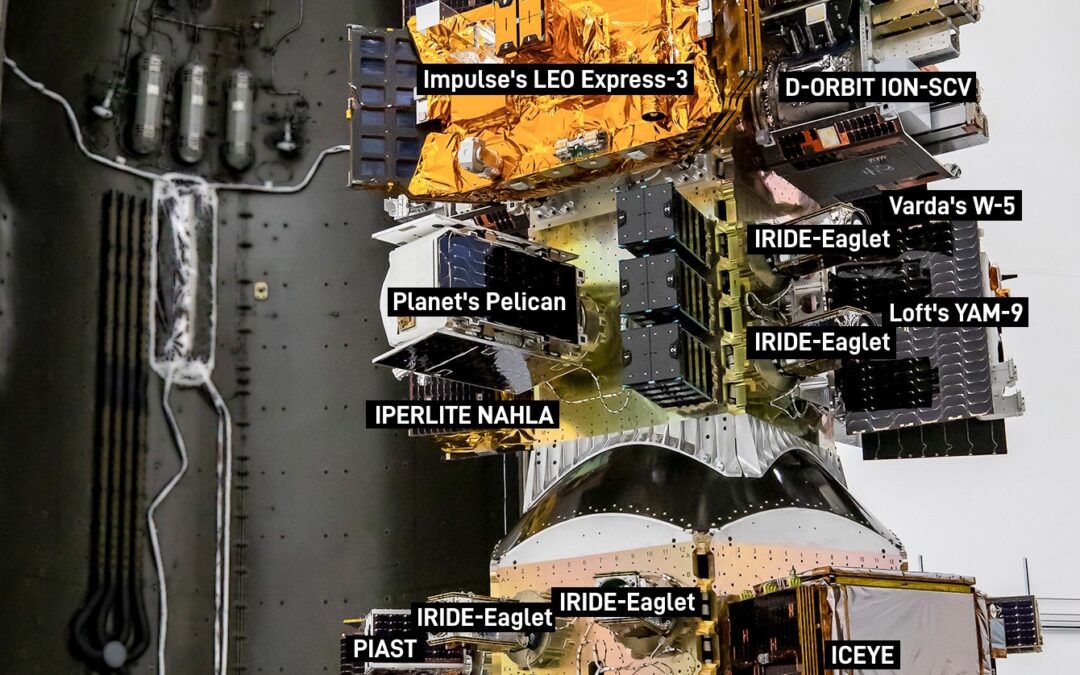
The SpaceX rocket carrying a partly-UNH-built cubesat launched successfully Nov. 28. The photo above shows the various satellites crammed inside the rocket. Here’s part of a UNH write-up on the satellite:
A team of 70 undergraduate students from the University of New Hampshire (UNH), Sonoma State University (SSU) and Howard University (HU) designed, developed and built a satellite which was named 3UCubed.
Selected as part of NASA’s CubeSat Launch Initiative, the satellite will travel to the Earth’s upper atmosphere, known as thermosphere. It will take measurements of the atmosphere density (single oxygen at this altitude) and electron precipitation from space onto the upper atmosphere, which can cause disturbances in communication signals and lead to changes in the ozone. Data from the mission will be collected by the students and analyzed in combination with data from IMAP and will help advance the understanding of how the thermosphere in the auroral and cusp regions responds to particle precipitation and varying conditions associated with solar wind.
CubeSats are a specific subset of satellites that are small and standardized and provide a cost-effective way to study space science. It is about the size of a loaf of bread and offers a simpler way to start building and operating than larger satellites, making it an ideal piece of equipment for students to hone their skills outside of the classroom.
The 3UCubed satellite was fully assembled at UNH and the two payload instruments that are a part of its structure were built, tested and calibrated at UNH. The students worked for five years on the satellite, performing a variety of tasks ranging from creating the software code that controls the 3UCubed to soldering the wires during the physical build. Students with mentorship from professors and staff engineers, performed trade studies, orbit analyses, selected vendors for different subsystems, oversaw budgets for various mass, power, link and telemetry jobs and developed the framework for the flight software and operations.
 Return to the Concord Monitor